
Four years ago, TIKI was seen as Vietnam's most promising e-commerce unicorn. Today, it has fallen below 1% market share (CafeF, 2026), while the rest of the market has been absorbed by the giant duopoly — TikTok Shop and Shopee .
For a German consumer brand preparing to enter Vietnam, a natural commercial question may emerge: should we launch first on TikTok Shop or Shopee?
Indeed, the better question is not only which platform your brand should choose. It is which playbook you can execute first.
Vietnam is becoming a two-platform market
In Vietnam, TikTok Shop and Shopee are increasingly competing for the same buyer, often with similar products, similar vouchers and similar campaign moments. But the two platforms still reward very different commercial capabilities.
In 2025, Shopee and TikTok Shop captured roughly 97-98% of Vietnam's Gross Merchandise Value (GMV) across four leading platforms (Shopee, TikTok Shop, Lazada, Tiki), and held that duopoly position into 2026 (YouNet ECI, 2026; Metric, 2026). Owned brand webshops, retailer apps and social-commerce channels still matter, especially for larger brands like adidas . But in Vietnam’s marketplace economy, Shopee and TikTok Shop have become the two platforms that shape discovery, pricing, trust and conversion at scale.
The speed of the shift is striking. TikTok Shop's revenue grew 93% year-on-year, while Shopee grew 6%. Lazada and Tiki together shrank from 6% to 3% market share. The market is not just growing — it is consolidating into two ecosystems.
In recent years, marketplaces in Vietnam are no longer just digital shelves where sellers list products. They have become traffic engines, payment layers, promotion systems, logistics interfaces, trust builders, and most significantly, entertainment channels.
Tiki case study: how a unicorn went invisible
German brands entering and scaling in Vietnam can learn from TIKI 's story. Started as an online bookstore in 2010, Tiki expanded into other categories and was once seen as one of the most promising local e-commerce platforms in Vietnam. Today, it holds barely 1% of GMV across Vietnam's four major online retail platforms (CafeF, 2026).
The story is not only that Tiki made mistakes. The story also shows how quickly the rules of e-commerce in Vietnam have changed. The market has moved from "who has the better online shop?" to "who controls the strongest commerce ecosystem and engages consumers better through entertainment-led shopping?”
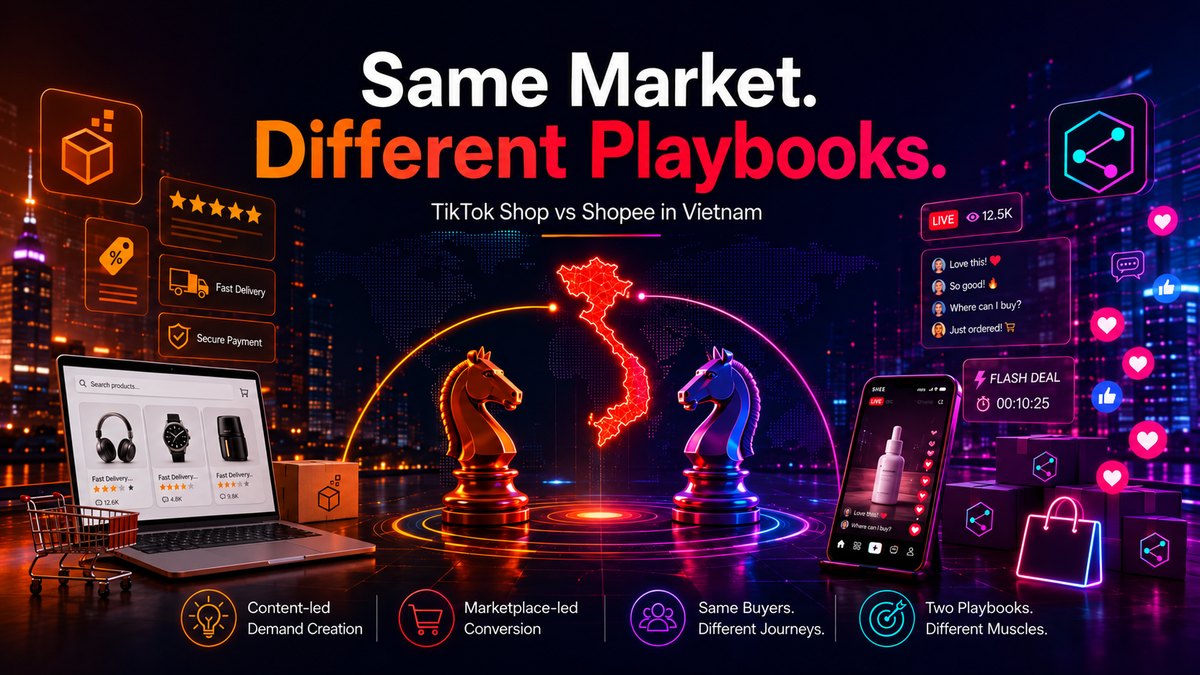
TikTok Shop and Shopee answered that new question by building different, yet complementary playbooks. TikTok Shop is built around content-led demand creation, while Shopee is built around marketplace-led conversion. Tiki, by contrast, remained closer to a pure e-commerce platform and could not keep pace with the shift toward shoppertainment.
Where each platform sits in the buyer’s journey
Vietnamese consumers often do not follow a clean, linear funnel. A buyer may discover a product through a TikTok livestream, then check reviews and alternatives on Shopee, then return to TikTok because a creator offers a better bundle, or complete the purchase on Shopee because the voucher, delivery promise or payment option feels stronger.
TikTok Shop is particularly powerful for storytelling. For example, a creator can demonstrate a Bosch Vietnam air fryer in action, show the difference between frying, roasting and baking modes, answer questions live and make the product feel familiar before the buyer has even searched for it. Still, the same buyer may go to Shopee to validate the decision: Is the seller trustworthy? Are there enough reviews? Is delivery fast? Is there a better bundle? Can I use a voucher? Can I pay later?
While Shopee also has livestream and short-form videos, the role is different. Shopee Live is closest to a closing channel: the viewer is usually already inside a buying journey, with the cart, vouchers and freeship promotions one tap away. This is why Shopee Live can be especially effective for higher-consideration categories such as appliances and electronics, where buyers often need reassurance before checkout.
TikTok Shop rewards content infrastructure
Winning on TikTok Shop is not only about having the right SKU or the right price. It requires a content engine: creator partnerships, short-form video testing, livestream formats, affiliate incentives, product hooks, bundles, scripts, samples, demonstrations and fast feedback loops. The platform is not just a place where people buy things; it is a place where people are shown why something might be worth buying.
A strong example is NIVEA Vietnam. In Germany, TikTok Shop is still a relatively new commerce channel, only introduced in 2025. In Vietnam, however, NIVEA has already treated TikTok Shop as part of its mainstream e-commerce playbook. According to YouNet ECI data reported by Brands Vietnam, NIVEA’s official stores across Shopee, Lazada and TikTok Shop sold 587,000 products and generated 84 billion VND (roughly 2.74 million EUR) in revenue in the first half of 2025, representing a 233% revenue-growth compared to the same period of the previous year. Although NIVEA only officially launched on TikTok Shop in the second half of 2024, TikTok Shop quickly became the brand’s second-largest e-commerce distribution channel.
However, TikTok-led demand can also be volatile. A successful livestream, creator video or affiliate push can create sudden spikes. If inventory, customer service, fulfilment and after-sales support are not ready, demand can quickly become operational stress. TikTok Shop can create demand quickly, but it also tests whether the brand can operationalise attention.
Shopee rewards marketplace discipline
Shopee works differently. The buyer often arrives with clearer intent. They search, compare, filter, check ratings, look at vouchers, read reviews and evaluate delivery options. Shopee is therefore less about creating the first moment of desire and more about converting existing intent.
This makes the operating model different. Winning on Shopee requires strong marketplace discipline: product titles, categories, keywords, ratings, review photos, campaign timing, voucher logic, fulfilment promises and response speed. Shopee is a system of ranking, trust and conversion. For German readers, its role is perhaps closest to Amazon : a place where consumers search, compare, check reviews and decide which seller they trust.
For a new brand, this is both helpful and difficult. It is helpful because buyers are already there with purchase intent. But it is difficult because new sellers start with limited review history. A listing with strong ratings, review photos and past sales has a structural advantage over a new listing, even if the new product is good. This is why the early phase on Shopee is not only about selling, but it is also about building trust assets.
Shopee also has trust mechanics specific to the Vietnamese market. One example is Shopee Đồng Kiểm(“Shopee Co-Checked”), where buyers can inspect the package in front of the courier before accepting it. For consumers, this reduces perceived risk. For sellers, it changes the operational reality of fulfilment and returns. This kind of detail rarely appears in a simple platform comparison, but it matters when building a real go-to-market plan.
The market is formalising
Vietnam's e-commerce market is not only growing. It is becoming more formal. The number of sellers on major platforms is consolidating while GMV continues to rise — a market moving toward fewer, stronger and more professional sellers.
At the same time, Vietnam is tightening its regulatory framework. The new E-Commerce Law was passed by the National Assembly on December 10, 2025, and is effective from July 1, 2026. It mandates seller and livestreamer identity verification through VNeID, raises seller and platform accountability, and adds explicit rules around livestream selling and tax (VnExpress, 2026). For brands, this matters. Vietnam should not be treated as a low-friction test market where a seller can simply upload products, run vouchers and learn later.
Formalisation also shows up in the economics of selling. Sellers on TikTok Shop and Shopee need to account for several fee layers, including platform commission, payment or transaction fees, voucher programme fees, order processing or infrastructure fees, and shipping-related costs. On top of that, if sales are creator- or affiliate-driven, KOC (key opinion consumer) commissions may add another 15–20% of product value. In practice, this means marketplace selling can easily absorb roughly 25–40% of gross revenue beforeproduct cost, fulfilment, returns and marketing overhead are even considered. Marketplace access is therefore not free traffic. It is a paid operating system.
Key takeaways for German brands
TikTok Shop rewards content infrastructure: creators, video, livestream, fast iteration. Shopee rewards marketplace discipline: listings, ratings, reviews, voucher mechanics, fulfilment reliability. The two platforms are converging, but they are not yet equal at each other's playbook.
Most importantly, the bar for e-commerce is rising in Vietnam. Seller fee, compliance, identity verification, product claims, fulfilment, customer service and platform rules are becoming part of the market-entry equation. This is especially relevant for categories involving machines, consumables, warranties, repeated purchases or imported production.
Therefore, for a German brand planning to enter Vietnam, the question is not which platform to choose. It is which playbook your brand can credibly execute first.
The platform choice is really an operating-model choice. A brand should not chase the platform with the strongest headline growth. It should choose the playbook it can execute credibly first, then build the missing capabilities to expand. Same market. Two playbooks. Different muscles.
Next in this series: why live shopping works in Vietnam — and keeps stalling in Germany.
#Vietnam #Ecommerce #TikTokShop #Shopee #LiveCommerce #RetailStrategy #SoutheastAsia #CommerceStrategy #ProNexum Consulting
Data & Sources
YouNet ECI — Vietnam E-commerce Overview 2025 (March 2026)
Metric — Vietnam E-commerce Q1 2026 Report
VnExpress — Shopee & TikTok Shop 2025 performance data
VOV.vn — Platform fee and market share analysis (May 2026)
Brands Vietnam / YouNet ECI — NIVEA Vietnam case study (Dec 2025)
CafeF — Tiki market share analysis (March 2026)
This article was first published on LinkedIn on 2 June 2026: original. It is provided for general information only and does not constitute legal, tax or investment advice.
More articles
 Germany and Vietnam
What does “Made in Germany” actually mean in Vietnam?
7 September 2026Read more → Germany and Vietnam
Fulfilment expectations are brutal in Vietnam. Germany plays by different rules.
30 July 2026Read more → Germany and Vietnam