
In May 2025, the Vice Chairman of a northern Vietnamese province went viral with a livestream selling 31 tonnes of regional lychees, assisted by the popular livestreamer and TikToker Chu Thanh Huyền.
In Germany, one in two Germans still does not know TikTok Shop exists after its first full year of operation, according to a YouGov survey reported by ZDF heute (March 2026). TikTok Shop is growing in Germany, and the numbers later in this piece make that clear. Still, the real question stands: why does the same format that lets a provincial official in Vietnam move an agricultural harvest in hours remain unknown to half of Germany after a full year?
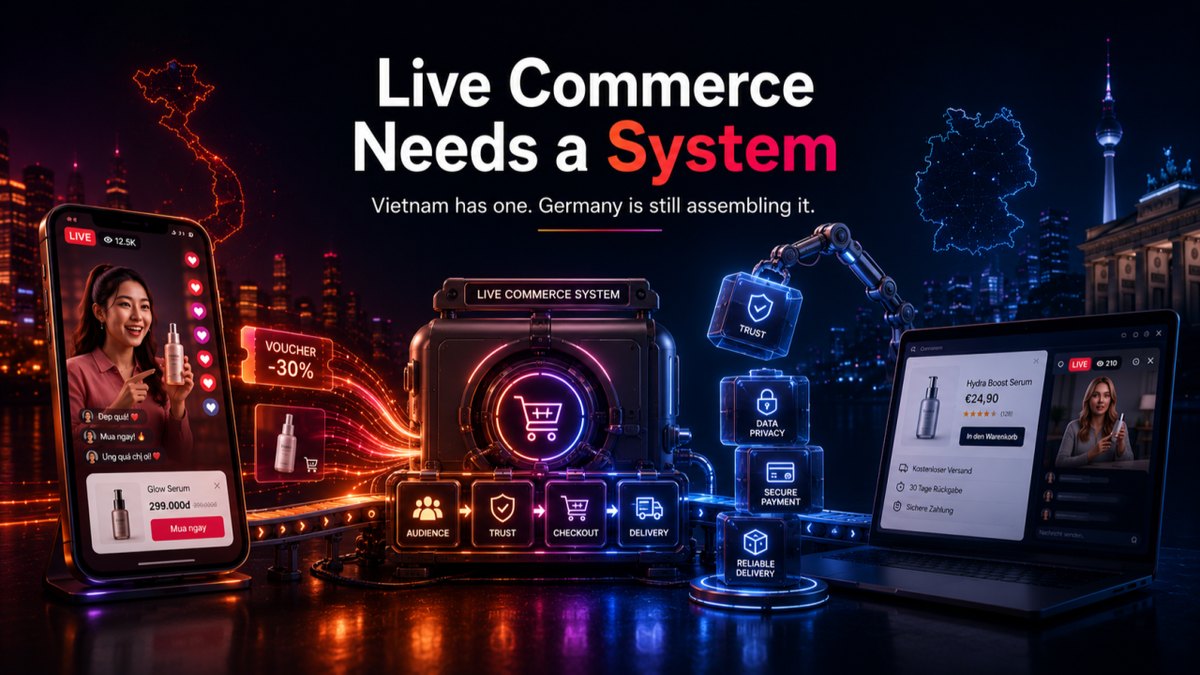
The article argues that the difference is not simply consumer appetite. It is structural. Live shopping works in Vietnam because the surrounding system: logistics, seller access, trust signals, platform habits, and product-market fit that arrived early and now reinforces itself. Germany is moving in the same direction, but more slowly and under different constraints, especially around data regulation, consumer trust, and retail culture.
For German brands, the lesson is not to reproduce Vietnam’s model directly, but to understand the system behind it. Live commerce scales when discovery, seller access, logistics, creator influence, and trust operate together. Germany has spending power and early proof points, but trust still has to be earned through reliable delivery, transparent data practices, credible creators, and products that benefit from live demonstration. The message is: brands that start now can learn the format and win the market before it becomes too crowded.
Who gets inside the door
A younger market, a wider platform base
On paper, the two markets are more alike than the headlines suggest. The TikTok app is open from age 13 in both countries, and TikTok Shop requires buyers and sellers to be 18 or older in both. Anyone looking for a rulebook explanation of the gap will not find one.
What differs is who stands behind those rules. Vietnam is a much younger market, with the median age around 33 and apopulation of over 102 million. The number of monthly active TikTok users has already reached 70 million in this country (VietnamNet Global, 2025), representing more than 68% of the whole nation. In contrast, Germany's median age is in the mid-40s, and TikTok's roughly 27 million users represent about only one third of the population. The platform-native, conversion-ready audience is structurally larger and younger in Vietnam, and its shopping habits were formed on social platforms in the first place. In both markets, teenagers aged 13-17, which can the cohort most responsive to trends and creators, can see the content without being allowed to buy. However, in Germany, the law adds a second layer, since under the Taschengeldparagraph (Section 110 of the Civil Code) purchases by minors without parental consent are only valid within small pocket-money amounts.
Who can sell — and at what cost
On the seller side, requirements are formally similar: both markets admit sole proprietors as well as registered companies. The practical difference lies in what registration entails. A German seller needs a registered business, a German VAT ID, a German bank account, identity and beneficial-owner verification, and additional certification before listing in categories such as cosmetics or electronics, all sitting on top of the general duties of German e-commerce law. Vietnam's requirements were lighter, essentially age, national ID and a tax code, which is why the seller base could grow to include market vendors and single-product shops, and why the platform long functioned closer to a public market than a curated retailer.
Recently, the gap is being tightened from the Vietnamese side: under the new E-commerce Law, sellers and livestreamers must verify their identity via the national VNeID system from July 2026. Cost pressure is also consolidating the Vietnamese seller base. Fee increases on dominant platforms like TikTok Shop and Shopee can push the total cost of selling to 40% or 45% of revenue (VOV, 2026), which can dramatically affect profitability and sustainability of small and medium-sized businesses.
The squeeze effect is also visible in market data. An industry executive quoted by VOV estimates that more than 70,000 small resellers (Customer-to-Customer) exited these platforms over the past year. Metric counts a roughly 7.5% drop in active shops across the four major platforms, to about 601,800 (Metric, 2026). The market is consolidating around sellers who can run livestream commerce as a genuine operation rather than a side venture.
The doors, in short, are formally open on both sides in both markets. What differs is how much operation it takes to walk through them, and how many people are already inside.
Inside Vietnam's live shopping: always-on and trend-first
Always on, always selling
Livestreams in Vietnam run 24 hours a day, seven days a week. The model is closer to a 24/7 convenience store than a scheduled broadcast event: always available, always selling, always cycling through new products. Sellers respond to what is trending this week and move on the next.
Furthermore, it extends beyond TikTok. As of late 2024, Facebook led livestream penetration in Vietnam at 62%, with TikTok at 53% (Decision Lab, Q3 2024, via VnEconomy). AccessTrade data from the same period reported that the three most popular platforms for live shopping are Facebook (31.9%), Shopee (30.9%), and TikTok (17.2%). The scale of the habit was already remarkable then: around 2.5 million selling livestreams a month, more than 50,000 sellers, and viewers spending roughly 13 hours a week watching (VnEconomy, November 2024). Since then, the balance has shifted fast. TikTok Shop's revenue grew 93% in 2025, lifting its share of marketplace GMV across the four major platforms to 39.6% and forming a near-98% duopoly with Shopee (YouNet ECI, 2026). That shift helps explain why Facebook is becoming less central: it still hosts a large share of livestream activity in Vietnam, but more of the transaction value is moving to platforms with integrated checkout, vouchers, logistics, and affiliate incentives.
From the customer perspective, the majority of Vietnamese consumers are very price-sensitive and not particularly brand-loyal. They may shift between sellers for a marginal discount or a better bundle without hesitation. For German brands built around consistency and long-term positioning, this is a genuinely different operating logic.
Beauty, fashion, and the gifting economy
The category dynamics reflect this. Fashion and beauty are the twin engines of live commerce in Vietnam, together contributing more than half of total livestream revenue in data compiled by Wifi Talents (2024, via VnEconomy). Both are fast, visual, demonstrable and heavily trend-driven.Within beauty, gifting is a particularly powerful purchase driver. Vietnamese consumers frequently buy beauty products as gifts, and the gifting occasion even shapes the decision more than the product itself. This changes what sells (bundles, sets, seasonal editions) and how sellers communicate value in a livestream.
The competitive structure is also highly concentrated. Live commerce rewards whoever captures attention first, and in a scroll-first environment, first-mover advantage compounds quickly. A striking example is Hannah Olala, one of Vietnam's most prominent KOLs and livestreamers in the beauty segment. Having over 3.4 million followers across TikTok and Facebook, she co-founded and ran the cosmetics company named Skinetiq. In February 2026, she became the first Vietnamese KOL to complete a corporate-level exit, selling 75% of Skinetiq to the Indian conglomerate Marico in a deal worth around VND 750 billion, roughly €24 million (Kenh14, February 2026). Creator, brand owner and sales channel in one person: that is the depth of integration German brands are up against.
The story is, a single dominant voice in a category can effectively set the commercial pace for every other seller in that space, and in Vietnam that voice may well own the brand, the audience, and the channel at once. Wholesalers, meanwhile, follow whatever is trending and build no product ranges; they build audiences around the product of the moment.
Community trust — and its limits
However, traceability and transparency are the flip side of the low entry barriers described above. The same conditions that make Vietnam's live commerce commercially dynamic also create opacity. Products of unclear origin, limited supply chain visibility and sellers with little accountability after the stream ends are still recurring and widely mentioned cases.
This explains why community trust in Vietnam frequently substitutes for institutional trust. Vietnamese consumers lean on what they simply call ‘cộng đồng review' (review group): Facebook communities and recently Threads groups among young audience, often hundreds of thousands of members strong, are built around candid product reviews and recommendations. The choice of platform is no accident: Facebook plays a far larger role in Vietnamese daily life and commerce than it does in Germany, where its user base is mainly older people and its commercial layer never took hold. For German brands operating under consumer protection obligations and supply chain due diligence requirements, this is a risk profile worth understanding before drawing comparisons.
Currently, even community trust is being renegotiated. Young Vietnamese consumers are increasingly turning away from TikTok reviews after repeated cycles of exaggerated content and post-purchase disappointment and now cross-check claims across platforms before buying (Kenh14, April 2026). The market data shows the same correction: in the second half of 2025, beauty sales through official 'Mall' stores grew 10% while sales through unverified shops fell 8%, as consumers paid more attention to origin and quality (YouNet ECI, 2026). The trust environment is fragile, but it increasingly rewards credibility, which is precisely the ground on which established German brands can compete.
Simply put, conversion does not end at checkout for live shopping. A stream can generate thousands of orders in minutes, but if the product fails to match the claim, negative reviews can travel just as quickly. Trust is therefore not only what closes the sale; it is also what determines whether the format remains commercially sustainable.
Logistics: how fast the parcel follows the impulse
Live commerce generates demand in real time. If the fulfilment window does not match the impulse, conversion is lost.
Vietnam: infrastructure built for the impulse
In Vietnam, TikTok Shop connects sellers with platform-linked third-party logistics providers, with shipping status synchronized directly inside the app. Same-day and next-day delivery is therefore operationally realistic for a significant share of sellers, particularly in urban centres like Ho Chi Minh and Ha Noi. The infrastructure and the commerce layer were designed together.
One distinctly Vietnamese pattern sharpens this. Young consumers, Gen Z above all, stay up late scrolling, and purchases routinely happen after 9pm, at midnight or even later. Some sellers have responded with dedicated late-night livestreams targeting exactly this group. The impulse made at midnight in Ho Chi Minh is rewarded with a parcel by end of next day, at least in the urban setting. In Germany, the same late-evening purchase simply enters a standard parcel cycle. The commercial moment is identical; the operational answer is not.
Even in a successful case like the Bắc Ninh lychee livestream, the Vice Chairman leading the session was candid: due to the fruit's highly perishable nature, deliveries were limited to major cities of Hanoi, Ho Chi Minh, Cần Thơ and Đà Nẵng. Logistics remained, in his words, the sector's biggest challenge.
Germany: reliable, but a step behind
In Germany, the shipping models are similar, but built with a different texture. Under Fulfilled by TikTok (FBT), TikTok's primary strategic partner is the logistics group FIEGE, which handles storage, picking, packing and next-day nationwide delivery (FIEGE, 2025); for fashion and lifestyle brands, Zalando's B2B unit ZEOS acts as a preferred partner for European inventory and cross-border routing (Zalando, 2025). Under Shipped by Seller, merchants fulfil orders themselves through approved carriers including DHL, Hermes, DPD, GLS and UPS, with shipment required within three business days of payment. Where FBT is used, next-day delivery is realistic; but a large share of the assortment is still shipped by sellers themselves, where dispatch alone can take three business days. The impulse does not wait. The operational window simply has to meet it.
Germany has seen this film before
Social commerce's recurring hurdle
TikTok Shop is not the first social commerce product to enter Germany with significant expectations. Facebook Marketplace never displaced Kleinanzeigen as the default home of German person-to-person commerce. It met an entrenched incumbent, and a consumer culture already sceptical of how the platform handled personal data.
The lesson, however, is not that Germans categorically reject the blending of entertainment and purchase. Younger German consumers are visibly changing, and TikTok Shop's own growth shows there is real appetite. The harder barrier is regulatory and reputational. Germany is a market that has consistently capitalised on protecting customers' data privacy, while TikTok, backed by ByteDance, is under formal EU Commission proceedings over addictive design and risks to minors, and faces persistent criticism over its data handling (ZDF heute, 2026). That tension, more than consumer culture alone, defines the headwind.
Slow by design, not by default
The numbers put this in context. Live shopping accounts for less than 1% of total online commerce in Germany, compared with 4% in the United States and over a third in China (ZDF heute, November 2025).
Whether that makes Germany a slow adopter depends on where one looks. By absolute e-commerce volume it is one of Europe's largest markets; in adopting new commerce formats it moves deliberately, and usually only after its trust questions have been answered. The Verbraucherzentrale NRW, Germany's largest consumer protection organisation, has specifically flagged live shopping's urgency mechanics, such as countdowns, scarcity signals and rapid auctions, as formats designed to push consumers into decisions they would not otherwise make. That is not a fringe concern in a market where consumer rights culture runs deep. It is the lived expectation of the buyer on the other side of the stream.
What is changing in Germany
The buyers are already there
The growth, however, is real, and it deserves its own ledger. According to NielsenIQ data reported by ZDF heute in March 2026, 15% of German online shoppers have purchased at least once on TikTok Shop, up from 10% in October 2025, as Handelsblatt reported at the time. One year in, TikTok Shop already ranks 15th by revenue among tracked German online retailers, and its buyers are spread relatively evenly across age groups up to 66.
The supply side is scaling too. TikTok’s German shop chief Max Burianek reports more than 25,000 sellers, ranging from small businesses to big corporations such as L’Oréal, Nivea, Philips, Samsung, and WMF, and says daily seller revenues nearly doubled in the past six months.
The buyers arriving are more valuable than the cautious narrative suggests. TikTok shoppers in Germany already spend €2,672 per year online, 30% above the German average of €2,036, and make 47 purchases per year, 40% more than average. The channel is not attracting low-spend browsers. It is attracting high-frequency buyers. Gen X, not Gen Z, accounts for 33% of TikTok buyers and 36% of platform revenue.
Two platforms, two models
The UK offers a preview. There, where TikTok Shop launched two years earlier, more than one in four online shoppers already buys regularly via the platform, and average spend has more than doubled from £62 to £131. NielsenIQ expert Stefan Heidenreich sees no fundamental reason Germany should perform differently.
TikTok is not building alone. By November 2025, eBay had launched its own live shopping format in Germany, joining Amazon Live. The format is becoming multi-platform, and @eBay’s approach offers a revealing contrast with TikTok Shop’s. In a recent episode of the @digital kompakt podcast hosted by Joel Kaczmarek , Dr. Saskia Meier-Andrae , who is Managing Director of eBay Germany, explained that eBay is not trying to copy Asia’s mass-market livestream model. Instead, it is starting with categories where communities already exist and where trust is the primary concern: coins, trading cards, watches, luxury handbags, and refurbished goods.
The mechanics are deliberately different from TikTok Shop’s scroll-triggered impulse model: fixed streaming schedules that audiences can plan around, low starting bids that create participatory energy, hosts with genuine product expertise rather than entertainment polish, and an interactive format where viewers can request items, vote on what comes next, and shape the show’s direction. Sascha Pallenberg 潘賞世 , who covers Asian tech markets from Taiwan and appeared on the same episode, framed the underlying principle clearly: trust, entertainment, and community must work together — entertainment alone creates attention, but trust and community are what turn that attention into repeat buying. That is the same thesis TikTok Shop and eBay are testing in Germany simultaneously, from very different starting points.
The category signal
The category pattern also shows that Germany is not rejecting the format itself. Vietnam's live commerce runs on fashion and beauty, and Germany’s first TikTok Shop year is converging in the same direction: fashion has become TikTok Shop Germany’s top revenue category, sitting at 17%, ahead of computing and electronics category of 16% and home and household at 14% (NielsenIQ, 2026).
Key Takeaways for German Brands
The difference between Vietnam and Germany is therefore not basic consumer appetite. It is the surrounding system: logistics speed, seller access, trust signals, data regulation and the maturity of the creator-commerce ecosystem.
In the end, the answer to the opening question is short. Live shopping works in Vietnam because its conditions arrived early and reinforce each other: open access on both sides of the transaction, logistics designed into the platform, categories built for demonstration, and a community-based trust culture that closes sales quickly, even as rising fees and fragile traceability reshape who survives.
Germany has the appetite, the spending power and now the first proof points. But each condition is still being assembled, and German consumers will not extend trust before the institutions they expect, from data privacy to reliable delivery, are visibly in place.
Germany is building the same conditions from a different starting point, at a different pace. That is not a reason to wait. It is a reason to start.
Data & Source
Germany: ZDF heute; Handelsblatt; NielsenIQ; Bitkom; digital kompakt; FIEGE; Zalando Corporate; TikTok Shop logistics documentation.
Vietnam: YouNet ECI; Metric; VietnamNet Global; VnEconomy; VOV; VnExpress; selected Vietnamese consumer and business media coverage.
These sources were used to cross-check market data, platform developments, fulfillment infrastructure, consumer behaviour and regulatory context around live commerce in Germany and Vietnam.
This article was first published on LinkedIn on 29 June 2026: original. It is provided for general information only and does not constitute legal, tax or investment advice.
More articles
 Germany and Vietnam
What does “Made in Germany” actually mean in Vietnam?
7 September 2026Read more → Germany and Vietnam
Fulfilment expectations are brutal in Vietnam. Germany plays by different rules.
30 July 2026Read more → Germany and Vietnam