
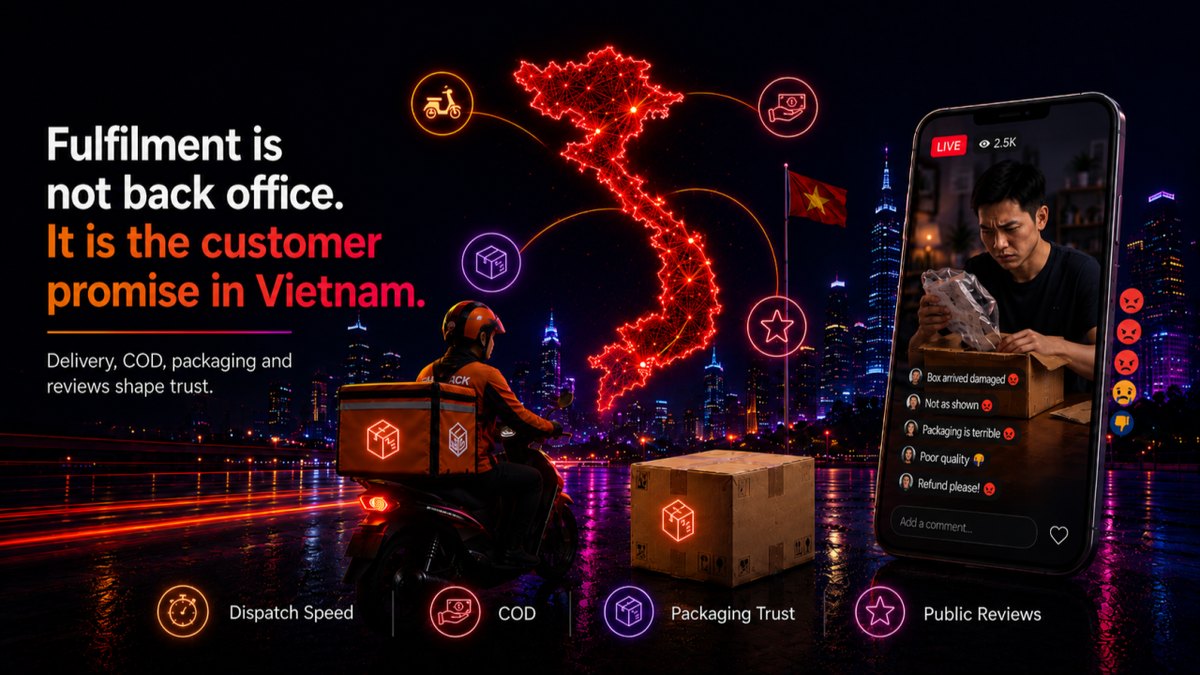
In Vietnam, a damaged parcel is not a logistics failure. It is content. TikTok buyers film unboxing videos, and a crushed box or a product that does not match the listing photo can reach tens of thousands of views before the seller's support team even knows it happened.
The article argues that in Vietnam, fulfilment is not a service layer that sits quietly behind marketing. It is scored, visible, and commercially decisive. Every step after the click, from dispatch speed and cash-on-delivery handling to packaging and returns, feeds directly into what buyers see and what platforms choose to show. The sale is not won at checkout. It is still being tested through confirmation, packing, delivery, payment collection, and return handling. The point is not that Vietnam is uniquely difficult. The point is that Vietnam exposes fulfilment weaknesses faster than almost any other market.
For German brands, the practical conclusion comes early: a strong product does not carry the customer experience on its own. The product may be German, but the experience is local: the courier handover, the packaging, the refund timeline. That is where the brand is judged, and why fulfilment belongs in the market-entry equation, not in the appendix of the distribution contract.
The baseline was set by a platform arms race, not by brands
TikTok Shop grew 93% year-on-year in 2025 while Shopee grew 6%, and the two now form a near-98% duopoly of marketplace transaction value (YouNet ECI, 2026). They did not only compete on price and product discovery. They competed on what came after the order confirmation: dispatch speed, seller accountability, return windows, and packaging standards. In Ho Chi Minh City and Hanoi, the two primary urban centers of Vietnam, the customer baseline for same-day or next-day delivery with real-time tracking was set by two platforms racing to out-fulfil each other, not by any single brand. The volume behind this is remarkable: Vietnam's parcel network handled 4.2 billion shipments in 2025, up 27% in one year, in an e-commerce market that reached USD 38.5 billion (VECOM EBI Report, 2026).
A German reader may fairly object that this sounds familiar. Amazon Prime trained German consumers to expect reliable one-to-two-day delivery years ago, and speed is indeed not the difference. The difference is what a failure becomes. In Germany, a failed delivery typically stays private: a support ticket, a return label, a refund request. When German customers do go public, the routes are formal and deliberate: a Trustpilot review, a complaint posted on Reklamation24 to force a public response, or a report to the Verbraucherzentrale (Germany's consumer advice centre) that can end in legal warnings. Even the familiar Trusted Shops badge is a paid certification merchants buy, not a channel where complaints spread. In Vietnam, the same failure can become viral content within hours and a platform penalty for the sellers within days. Speed is the shared baseline. Consequence is not.
COD is not a payment method, it is a risk structure
It is tempting to manage fulfilment abroad the way it is managed at home: invisible when it works, a support ticket when it does not. Vietnam's payment reality punishes that assumption, and cash-on-delivery (COD) is the clearest example.
Despite years of digital payment growth, 85% of Vietnamese e-commerce businesses still accept cash for their orders (VECOM EBI Report, 2026), and COD remains a default checkout option on every major platform. When a Vietnamese buyer places a COD order, they have not paid. They have expressed intent. If the courier cannot reach them after two or three attempts, or they refuse the package at the door, the parcel travels back to the seller, who bears the return shipping in most cases. On Shopee, that fee runs up to 40,000 VND per order, about 1.30 euros. Small per parcel, structural at volume, and always without revenue attached.
One Vietnam-specific mechanic sharpens this further. Under Shopee Đồng Kiểm("Shopee Co-Checked"), buyers of orders up to 3 million VND, roughly 100 euros, may open the parcel in front of the courier and check the items' condition and quantity before accepting. A product that does not match the listing is refused on the spot, with free return for the buyer, and the rejection lands on the seller's record.
Even a successful COD order is not cash. The platform collects the money and settles it later: TikTok Shop pays out seven days after delivery as standard, up to fifteen for some shops, with funds frozen during any active dispute. Payment risk, reconciliation, and payout cycles sit on top of the delivery job itself.
In Germany, Nachnahme, the direct equivalent, is effectively dead; consumer protection agencies such as the Verbraucherzentrale have long warned about unsolicited parcels and payment-on-doorstep scams. The German default became the structural mirror image: Kauf auf Rechnung, where the buyer receives goods first and pays later. However, only about 25% of B2C e-commerce transactions in Germany are paid this way, and B2B follows different rules. Still, it shows that the trust direction is the same, goods before money, only the operational consequence is different. A non-paying German customer becomes a collections case. A non-accepting Vietnamese customer hands the parcel back to the courier at the door.
The parcel is where the brand becomes real
In Vietnamese e-commerce, the parcel is often the buyer's first physical contact with the brand. The expectation is captured in a phrase common across community review groups: "hàng thật như hình", meaning the product is exactly as shown. When it is not, the response is public and fast.
Germany's packaging culture runs in the opposite direction. The Verpackungsgesetz (Packaging Act) requires sellers to register with a recycling scheme and pay fees proportional to packaging material, and combined with strong consumer preference for sustainability, this has pushed German e-commerce packaging toward functional, low-waste minimalism. Elaborate unboxing reads as excess rather than quality.
In Vietnam, minimalist packaging can read as low effort, and it risks not surviving the journey. Shipping a five-kilogram parcel within Ho Chi Minh City costs just over one euro; sending it 1,700 kilometres to Hanoi costs three to four euros. That price level built the market's speed habit, but its flip side is rough handling: motorcycle-based courier networks and multiple handoffs between city and province. Currently, in e-commerce platforms in Vietnam, the courier is platform-assigned: sellers hand the parcel over and lose control of the journey from that moment. TikTok Shop compensates sellers for verified in-transit damage, but the unboxing video and the buyer’s memory attach to the brand, not to the courier. Packaging is therefore the one lever a seller fully controls.
Experienced sellers photograph every sealed parcel before handover and use tamper-evident stickers, because those photos are the standard evidence in disputes. Packaging designed for German shelf aesthetics does not automatically survive a Vietnamese delivery route.
Fulfilment score is marketplace visibility
On Shopee and TikTok Shop, fulfilment performance determines what buyers see. Dispatch speed, cancellation rate, response time, and dispute rate feed a seller score that decides search placement and campaign eligibility. The deadlines are unforgiving. TikTok Shop now expects orders placed before 2pm to be handed to the courier the same working day, automatically cancels orders not ready to ship within two, and gives sellers a single day to respond to a return request before the refund is approved on their behalf. Shopee allows two days.
German Amazon sellers will recognise the logic of Buy Box eligibility (officially renamed the "Featured Offer"). What differs is the social layer. A poor fulfilment experience in Germany stays largely in private channels. In Vietnam it surfaces on TikTok, in Shopee reviews, and in Facebook community groups within hours, so the platform score and the social signal fall together.
This creates a specific blind spot for brands selling through distributors: the seller's fulfilment performance is the brand's marketplace presence. A distributor whose score is sliding due to COD returns, slow dispatch, or packaging complaints is quietly shrinking the brand's reach, and the brand is often the last to know. Live commerce makes this acute. A single livestream can generate hundreds of orders in minutes, and if the operation cannot absorb the spike, the demand that content created turns into penalties, refunds, and public complaints.
Self-audit for brands: seven questions before the first order ships
Vietnam does not demand perfection. It demands discipline in five places: order handling, packing, delivery, payment, and returns. Before entering, a brand should be able to answer yes to each of these:
Can we see fulfillment performance by channel, seller, and region, not just sell-in volume to a distributor? Do we know where orders fail: confirmation, stock, packing, delivery, COD refusal, return, or refund? Are marketplace seller scores tracked as strategic KPIs, reviewed like revenue? Is packaging engineered for Vietnamese handling conditions, not only for brand aesthetics? Can we absorb a livestream or campaign spike without breaching dispatch windows? Is ownership clearly split between brand, distributor, marketplace, and logistics partner? Can complaints be resolved within the platforms' 24-to-48-hour windows?
Any "no" on this list is not a detail to fix later. It is a visibility leak that the platforms will price in from day one.
Key takeaways for German brands
Vietnam's fulfilment environment is close to the structural inverse of Germany's. German consumers operate inside a codified legal framework: 14-day return rights, formal dispute mechanisms, a payment culture built on trust after delivery. Vietnamese consumers operate inside a platform-constructed trust layer that is faster, more social, and less forgiving. COD is the default, not the exception. Packaging is a public brand moment, not a cost line. Marketplace visibility is earned through fulfilment performance, not bought through marketing spend.
In the end, the customer promise ends at the same place in both markets: the moment the customer feels the risk of buying online was handled fairly. Vietnam simply decides that moment faster, and in public.
For German brands, the risk is not weak marketing. The bigger risk is making a promise the operating model cannot keep.
Earlier in this series: What Europe can learn from Vietnam about the next phase of commerce | Same market, different playbooks: how TikTok Shop and Shopee compete | Why live shopping works in Vietnam and keeps stalling in Germany
Data & Sources
VECOM — Vietnam E-Business Index Report 2026 (May 2026)
YouNet ECI — Vietnam E-commerce Overview 2025 (March 2026)
TikTok Shop Seller Center — Order Fulfillment Timeframes, Standard Orders (updated July 2025)
TikTok Shop Seller Center — Order Cancellation, Return & Refund Policy (updated June 2026)
TikTok Shop Seller Center — Seller Payment Settlement Policy
Shopee Help Center — Shopee Đồng Kiểm Program Overview
Shopee Seller Education — Shipping Rate Policy for Returns & Refunds
EHI Retail Institute — Online-Payment Study 2025 (invoice share of German e-commerce)
Verbraucherzentrale — Nicht bestellte Ware erhalten: was tun?
This article was first published on LinkedIn on 30 July 2026: original. It is provided for general information only and does not constitute legal, tax or investment advice.
More articles
 Germany and Vietnam
What does “Made in Germany” actually mean in Vietnam?
7 September 2026Read more → Germany and Vietnam
Why Live Shopping Works in Vietnam – and Keeps “Stalling” in Germany
29 June 2026Read more → Germany and Vietnam