
In Vietnam, “Made in Germany” is one of the few country labels that can justify a higher price before a buyer has examined the product in any detail. It is, however, increasingly, not enough on its own.
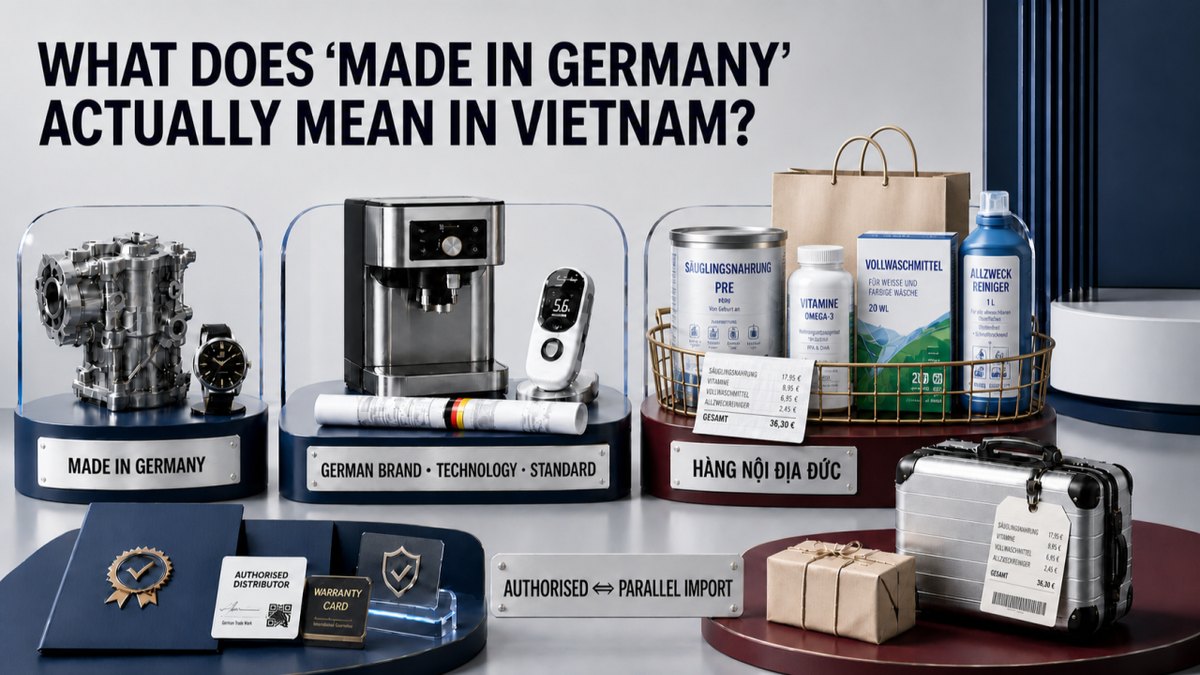
Vietnamese buyers now meet German-ness in several forms. Alongside Made in Germany there are German brands manufacturing internationally, công nghệ Đức(German technology), tiêu chuẩn Đức (German standard), and hàng nội địa Đức (goods promoted as intended for the German market). Each describes a different connection to Germany, and the Vietnamese market increasingly gives buyers reasons to tell them apart.
The question worth asking is not whether the label still works, but what it actually signals, and what German companies have to prove once it has done its job.
In short: “Made in Germany” signals engineering excellence, durability, safety and premium credibility, and it works hardest in high-consideration categories where failure is expensive. Its appeal may extend beyond affluent buyers, but its commercial reach is constrained by price. In consumer markets, that can delay purchase or make it occasional; in B2B, it raises the burden of demonstrating lifecycle value. What converts reputation into a sale is no longer the origin claim alone, but the proof around it: authorised distribution, service capability and a clear case for long-term value.
For this article, I interviewed Mr. Peter Kompalla , Chief Representative of AHK Vietnam - Delegation of German Industry and Commerce in Vietnam , on B2B market entry for German small and medium-sized enterprises, the commercial value of the “Made in Germany” signal, the Energy Export Initiative (German Energy Solutions Initiative) and workforce development. This piece opens a series on the Germany-Vietnam business relationship.
What the label signals, and where it works hardest
Historically, the label was not created by Germany as a quality promise. Britain introduced country-of-origin marking under the Merchandise Marks Act in 1887 for identification rather than endorsement, and German goods were among those affected (German History Intersections, 2023). Within a decade the meaning had begun to invert.
“The ‘Made in Germany’ label continues to hold strong value in Vietnam, where it is closely associated with quality, reliability, and technical excellence.”
Peter Kompalla, Chief Representative, AHK Vietnam
Those three words unpack into a specific set of expectations. Engineering excellence, meaning precision and technical rigour. Durability, products built to last rather than to look attractive. Safety and compliance, in categories where standards are the point. Premium credibility, where a higher price feels justified by lower long-term risk. And a degree of professional status, since German equipment, vehicles and qualifications reflect on whoever selected them.
The signal is strongest in high-consideration purchases: automobiles, industrial equipment, medical technology, household appliances and chemicals. Failure in these categories is expensive and difficult to reverse, so country of origin becomes an early indicator of quality, reliability and risk.
Where the signal runs out
Premium credibility and limited reach are the same property viewed from two sides. A label that persuades buyers to accept a higher price also concentrates the brand among the buyers who can pay it.
Vietnam’s car market illustrates the constraint. In 2025 the market set a sales record of 604,134 vehicles, of which VINFAST , the country's largest domestic automotive brand that builds electric vehicles exclusively, alone took 175,099, roughly 29%, with Toyota Motor Corporation next at 71,954, close to 12% (VnExpress, 2026). German brands remain strong in the premium segment, though not unchallenged: Mercedes-Benz AG held the luxury lead in 2025, while Toyota-owned Lexus narrowed the gap and finished ahead of BMW Group (VnExpress, 2026). That segment is in any case a narrow slice of a market whose volume is decided on purchase price, running costs and resale value. Discounting points the same way.
In August 2025, some German premium models were discounted by VND 100–450 million, equivalent to roughly €3,000–€15,000, depending on the model and production year. The reductions spanned several segments and included older inventory, so they indicate price pressure rather than settle the question (VOV, 2025). Few Vietnamese buyers would dispute that a German car is well made. Rather fewer are in a position to buy one.
“Price sensitivity can also be a challenge, as German solutions are often positioned in the higher-quality segment and may require clear communication of long-term value and lifecycle benefits.”
Peter Kompalla, Chief Representative, AHK Vietnam
In short, the challenge is to make long-term value tangible. While a lower purchase price is visible immediately, the benefits of durability, lower operating costs and dependable service emerge over time. The label may create the expectation, but it cannot provide the evidence on its own.
What “German” means beyond the origin label
Part of what complicates the signal is that several different claims now travel under it, and some of that vocabulary is specific to Vietnam.
Made in Germany is a claim about manufacturing origin. It is a voluntary designation, not a government-issued certification, but companies cannot use it without restriction. German chamber guidance holds that the decisive production steps, and the characteristics buyers actually value, must originate in Germany, and misleading use can be challenged under origin and unfair-competition rules (IHK Köln, 2024). What it does not do is certify technical superiority.
A German brand is a different claim again. German companies frequently manufacture across international production networks while retaining German engineering, design and quality management. Duravit AG , for instance, produces sanitary ceramics, bathroom furniture, bathtubs, showers and related fittings in Germany and at sites across Europe, Africa and Asia (Duravit, 2026). This is normal industrial practice rather than a dilution of anything.
Công nghệ Đức (German technology)and tiêu chuẩn Đức (German standard) point in different directions from each other. German technology refers to method: an engineering approach, process or component said to originate in German development. German standard refers to a benchmark: the claim that a product meets a specification associated with Germany. Neither is an origin claim, and neither requires German manufacturing. Both can be entirely legitimate, since a product can genuinely be built to a German specification without being made in Germany.
Hàng nội địa Đức (German domestic-market goods) runs the other way, treating the destination market as part of the product. It refers to goods intended for German consumers themselves, and appears most in infant formula, vitamins, detergents and household goods, often sourced from dm-drogerie markt Deutschland and Dirk Rossmann GmbH , with resellers offering German-language packaging and receipts as evidence. One context that may help explain the demand is the lasting regional sensitivity around infant-food safety after the 2008 melamine crisis, which reached Vietnam when the Ministry of Health identified melamine in eighteen food products and ordered them recalled (CBC News, 2008). Whether the resulting preference is justified is another matter. Differences in formulation, packaging or specification can reflect different regulatory requirements rather than different levels of quality, and the strongest claims of domestic-market superiority often come from resellers who benefit from making them.
Authorisation is becoming part of the proof
This leads to a distinction that shapes a great deal of Vietnamese commerce: chính hãng and xách tay. The first refers to goods distributed through official or authorised channels, with local documentation, warranty and after-sales support. The second refers to goods brought into Vietnam through personal or parallel-import routes.
Parallel-imported goods are not merely counterfeit because they enter Vietnam outside authorised channels. Vietnam applies international exhaustion of rights: under Article 125(2)(b) of the 2022 Intellectual Property Law, a rights holder cannot prevent circulation of products they or an authorised party already placed on a market (Intellectual Property Law, 2022). Selling them commercially is a separate question and can trigger customs, tax, labelling, traceability and consumer-protection obligations under Decree 98/2020, as amended by Decree 24/2025.
Origin and channel therefore do not always point the same way. A product genuinely bought in Germany may arrive with no warranty, service or import documentation, while one made outside Germany may arrive through an official distributor with full traceability. For part of the market, proximity to Germany is the stronger signal. For another part, and increasingly, the authorised channel is.
The direction of travel is visible on the platforms. TikTok Shop Mall requires sellers to submit brand authorisation documentation, and Mall status carries a higher commission in exchange for greater visibility and trust, which is why smaller sellers now invest in it (TikTok Shop Vietnam, 2026). On Shopee platform alone, imported goods generated around VND 5 trillion from 69 million sold items in the first half of 2026, with revenue down 23% and unit sales down almost 57% year-on-year. The gap between those two declines is the telling part: buyers are purchasing fewer imported items at a higher average value, while the category’s share of total sales shrinks (Metric, 2026).
For two platforms that have competed largely on discovery and price, as an earlier article in this series described, that is a meaningful change. Bosch shows the same logic from the brand side: BSH Vietnam was established in January 2023 and has built a distribution network of roughly 1,000 distributors, alongside official stores on Shopee and Lazada (The Investor, 2023). The brand did not rely on its name to carry the market. It built the infrastructure that lets a buyer confirm what they are purchasing.
As earlier articles in this series have discussed, a promise made at the point of sale tends to be judged well after the click. An origin claim creates the expectation. The channel is increasingly how it is verified.
In B2B, the same signal faces a harder test
The consumer market makes these dynamics visible. In B2B they become more expensive.
A Vietnamese manufacturer evaluating German automation equipment, an industrial machine or an energy solution is not buying a national reputation. Reliability has to appear in specifics: uptime, maintenance intervals, energy consumption, production consistency, spare-part availability, technical support response times and the working life of the equipment. A higher acquisition price can be entirely rational if those factors produce a lower total cost of ownership, but that case has to be demonstrated rather than assumed, and demonstrating it is a commercial discipline rather than a marketing one.
AHK Vietnam identifies strong opportunities in sectors tied to Vietnam’s industrial development and green transition: machinery, automation, renewable energy and energy efficiency, industrial equipment, medical technology, logistics and industrial services. It also sees the obstacles clearly: regulatory and administrative complexity, differences in business culture and decision-making, and the practical difficulty of identifying reliable local partners.
“The ‘Made in Germany’ label serves as an entry point by building trust and recognition, while the Energy Export Initiative helps convert this reputation into concrete partnerships and business opportunities.”
Peter Kompalla, Chief Representative, AHK Vietnam
That distinction is the practical heart of this. The label shortens the distance to a first conversation, particularly where German technical expertise is already recognised. It does not identify the right local partner, build service capacity, adapt a commercial model to Vietnamese purchasing behaviour, or explain why a higher upfront price produces greater value across an investment’s life.
B. Braun Group illustrates the alternative. The German medical technology group runs two plants in Hanoi, the first of which opened in Thanh Oai (Hanoi) in 2011 with the then German Chancellor, Angela Merkel, attending the inauguration. Together they account for more than USD 100 million in investment and over 1,300 employees, in what has been described as Vietnam's largest medical device production complex (EuroCham Vietnam, 2020). That is not a company exporting a reputation. It is a company building the local capability that lets the reputation be tested and confirmed.
The relationship is becoming two-way
A simplified view of the bilateral relationship would place Germany as the source of high-value technology and Vietnam as the market receiving it. What German companies are actually doing complicates that. Bosch’s CVT pushbelt operation in Long Thành, Đồng Nai, has run since 2008 and has been described as the company’s largest facility of its kind worldwide, supplying customers well beyond Vietnam (Vietnam Investment Review, 2018). BMW builds cars locally (BMW Group, 2022). Together with B. Braun’s Hanoi operation, these point to something the origin label was never designed to express: German engineering capability and Vietnamese manufacturing are no longer at opposite ends of a value chain.
The scale supports it. Germany is Vietnam’s largest trading partner within the European Union, with bilateral trade exceeding EUR 21 billion in 2025 and more than 500 German companies represented in the country (German Federal Foreign Office, 2026).
What the label is worth now
“Made in Germany” began as a way of marking goods as foreign and became a shorthand for industrial quality. In Vietnam it remains one of the most valuable reputational assets a company can bring to market, and it does something few marketing claims manage: it earns attention, and tolerance for a higher price, before the product has been examined.
What it no longer does is finish the argument. The market now gives buyers more reasons to ask which version of “German” they are being offered, whether the seller is authorised, and what the premium delivers over time. The label opens the conversation. Distribution, service and demonstrated value conclude it.
This makes the more interesting question less about what Germany can sell to Vietnam, and more about what the two countries are building together.
This article draws on an interview with Peter Kompalla , Chief Representative of AHK Vietnam - Delegation of German Industry and Commerce in Vietnam , on German-Vietnamese business cooperation, B2B market entry for German SMEs, the Energy Export Initiative (German Energy Solutions Initiative) and workforce development. The article is intended for general informational purposes only and does not constitute legal advice.
Data & sources
AHK Vietnam — Current status of German investments in Vietnam 2025/26
BMW Group — Local assembly in Vietnam with THACO AUTO (2022)
Bosch Vietnam — Bosch in Đồng Nai
CBC News — Vietnam bans 18 food products containing melamine (October 2008)
Duravit — Global production sites
EuroCham Vietnam — One of the largest medical complexes in Vietnam: B. Braun Vietnam
German Federal Foreign Office — Germany and Viet Nam: bilateral relations (2026)
German History Intersections — The Merchandise Marks Act of 1887
German History in Documents and Images — E. E. Williams, Made in Germany (1896)
IHK Köln — Herkunftsangaben, Kennzeichen und “Made in Germany” (2024)
IHK Schwerin — Fact sheet “Made in Germany”
Metric, reported by Tiền Phong — Shopee, TikTok and Lazada find their “gold mine”: first-half 2026 e-commerce data
Luật Minh Khuê — Bán hàng xách tay có phải là trốn thuế không?
Schindhelm — “Made in Germany”: how reliable is information about origin?
Socialist Republic of Vietnam — Intellectual Property Law, Article 125(2)(b) (2022)
Socialist Republic of Vietnam — Decree 24/2025/ND-CP amending Decree 98/2020 (February 2025)
The Investor — Bosch Home enters the Vietnam market (January 2023)
Tilleke & Gibbins — New administrative penalties in commercial activities (2025)
TikTok Shop Seller Center — Seller terms of service (Vietnam)
TikTok Shop Seller Center — Requirements for brand authorisation
Vietnam Investment Review — Bosch expands its Đồng Nai powertrain plant (2018)
Vietnam.vn — Luxury cars discounted by hundreds of millions of dong (August 2025)
VnExpress — Vietnam’s car market sets a sales record (2026)
VnExpress — Luxury car market 2025: Lexus closes on Mercedes (2026)
VOV — Models discounted by hundreds of millions of dong (August 2025)
This article was first published on LinkedIn on 7 September 2026: original. It is provided for general information only and does not constitute legal, tax or investment advice.
More articles
 Germany and Vietnam
Fulfilment expectations are brutal in Vietnam. Germany plays by different rules.
30 July 2026Read more → Germany and Vietnam
Why Live Shopping Works in Vietnam – and Keeps “Stalling” in Germany
29 June 2026Read more → Germany and Vietnam