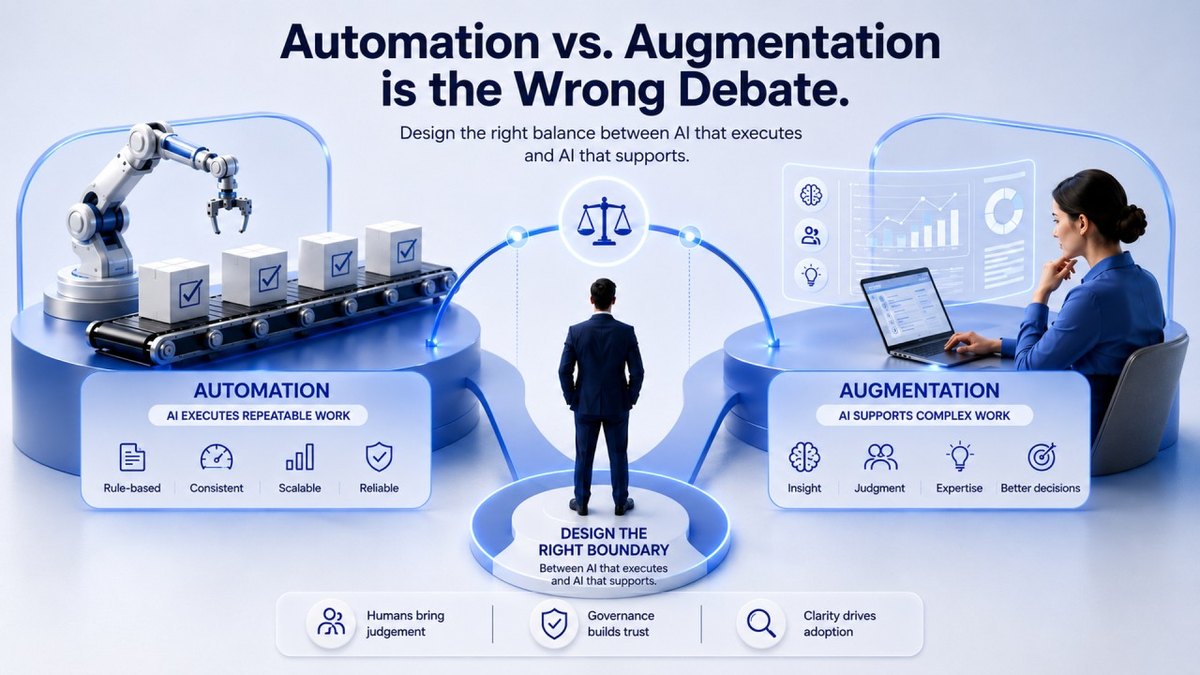
AI does not ask leaders to choose between automation and augmentation. It asks them to design the boundary between the two.
In practice, AI creates two different shifts.
Some tasks will be automated because they are repetitive, rule-based, and low-risk. A customer service chatbot that resolves standard requests - such as order status, refunds, or simple account questions - is a typical example. Klarna’s AI assistant, for instance, reportedly handled around two-thirds of customer service chats in its first month.
Others will be augmented because they require judgment, context, creativity, or accountability. In manufacturing, the Siemens Industrial Copilot is a good example: it helps engineers and maintenance teams work with operational data, automation logic, and technical documentation, but the human expert still interprets the recommendation and decides what should happen next.
This distinction is also central in management literature. Sebastian Raisch and Sebastian Krakowski define automation as machines taking over a human task, whereas augmentation means that humans collaborate closely with machines to perform a task. Their key point is that the two are not cleanly separable, but interdependent.
This is where the real leadership question begins.
It is not: should AI replace work or support people? But: which parts of a workflow should AI take over, where should humans remain responsible, and how should that boundary be managed?
1. Automation
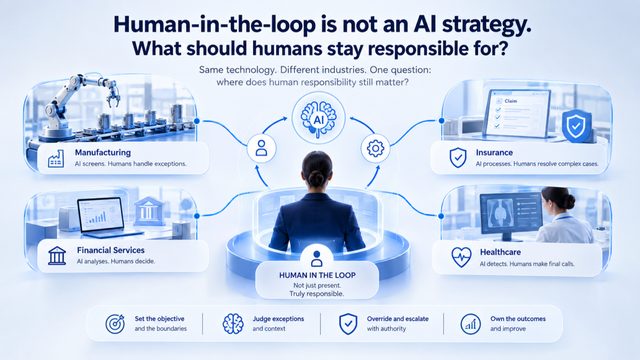
Automation means that AI or another machine-based system takes over a task that was previously performed by a human. The important point is not that there is never any human involvement. In many business settings, humans still design the rules, monitor performance, handle exceptions, or intervene when something goes wrong.
A good example is recruiting. In large-scale talent acquisition, AI can take over repetitive steps such as screening applications, matching candidates against predefined criteria, or ranking profiles for review. Raisch and Krakowski point to Unilever’s use of AI-based solutions in its talent acquisition process. The human role does not disappear, but it shifts from manually processing every application to supervising the system, reviewing exceptions, and making final hiring decisions.
Automation is attractive because it promises speed, consistency, and scale. It can reduce manual effort and make processes less dependent on individual availability.
This is where leaders need to be careful. Automation can increase speed and consistency, but it can also introduce new costs, new risks, and new dependencies. The question is therefore not simply whether a task can be automated, but whether automation improves the workflow as a whole.
Recent reporting by Axios shows why this matters. Worldwide IT spending is expected to reach $6.31 trillion in 2026, up 13.5% from 2025, with AI infrastructure, software, cloud services, and subscriptions contributing to the increase. Axios also notes that some companies are already spending more on AI than on employee salaries, and cites examples where token costs have consumed AI budgets faster than expected. The point is not that AI is “too expensive.” The point is that AI execution becomes a new operating cost - and therefore needs a clear business case.
Automation creates value when it improves the workflow as a whole. It can reduce cycle time, increase consistency, improve reliability, lower operational risk, and free human capacity for higher-value work. But if the underlying process is not redesigned, automation can also shift effort elsewhere - into monitoring, exception handling, governance, or cost control. Governance, in this context, means setting clear rules for when AI can act independently, when people need to step in, and who remains accountable for the outcome.
2. Augmentation
Augmentation means that AI enhances human work instead of replacing the human role. The task is still performed by a person, but AI improves how the person searches, analyzes, compares, drafts, or prepares a decision. The human remains responsible for framing the problem, interpreting the output, and deciding what happens next.
A good example is drug discovery. Raisch and Krakowski point to Pfizer’s use of AI-based solutions in drug discovery and development. In this context, AI can help scientists search through complex data, detect patterns, generate hypotheses, and prioritize research directions. But the human expert still evaluates scientific plausibility, weighs trade-offs, and decides which direction to pursue.
This pattern also appears in financial services and software development. Morgan Stanley’s internal GPT-based assistant helps wealth advisors search and synthesize large volumes of internal research and knowledge, while the advisor remains responsible for the client conversation and recommendation. GitHub Copilot helps developers write and review code faster, but the developer still decides whether the code is correct, secure, and suitable for the product.
In each case, AI improves the work, but it does not remove human judgment and control.
But augmentation also has limits. The productivity upside of augmentation can be significant. In a field study with 5,172 customer support agents, access to a generative AI assistant increased productivity by about 15% on average, with the largest gains among less experienced workers. A separate GitHub Copilot experiment found that developers completed a coding task 55.8% faster with AI assistance than without it.
But these numbers do not mean that augmentation creates value automatically. If every AI-supported output still requires full human review, the process may become faster at one point and slower overall. If employees rely too heavily on AI outputs, organizations create new risks around deskilling, complacency, and unclear accountability.
The lesson is that augmentation is not just “AI plus human.” It only works when the human role is redesigned as well: what the person checks, where they add judgment, when they override the system, and who remains accountable for the final outcome.
3. The Paradox
The paradox is that automation and augmentation are not opposites. They reinforce each other.
First, augmentation often becomes the learning phase for automation.
When employees use AI to support a task, the organization starts to see which parts of the workflow are repetitive, which exceptions occur often, which decision rules are stable, and where data quality is good enough. Over time, these insights can make selective automation possible.
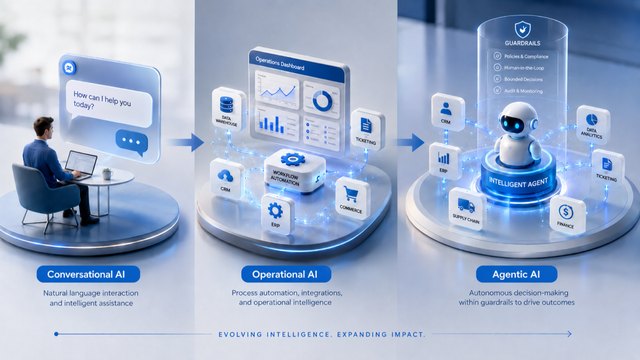
Customer service is a good example. At first, AI may only support agents by suggesting answers or summarizing previous interactions. As the organization learns which requests are predictable, low-risk, and frequently repeated, some of these interactions can gradually move from AI-supported service to automated resolution.
Second, automation creates new human work.
When AI takes over standard execution, the need for human involvement in that specific task can shrink significantly. In industrial plants, warehouses, call centers, or back-office processes, automation can significantly reduce or replace human work in particular roles. But at the operating model level, it also creates new human work around supervision, exception handling, quality control, rule updates, performance monitoring, and governance.
In other words, automation does not simply remove humans from the organization. It changes where human work is needed.
Third, both approaches can create problems if they are not designed deliberately.
Too much automation can create hidden risks, weak accountability, and loss of human expertise. Too much augmentation can create overloaded workflows where every AI output still needs review. Software development illustrates the tension: GitHub Copilot can speed up coding tasks, but developers still need to review correctness, security, and fit with the wider codebase. In complex or proprietary contexts, studies also show that AI assistance can struggle, which means augmentation must be designed around review and accountability rather than treated as automatic productivity.
That is the automation-augmentation paradox: AI can take over parts of work, while at the same time making human judgment, supervision, and accountability more important.
4. What this means for the Operating Model
This is where the automation-augmentation paradox becomes practical.
The question is no longer simply which tasks can be automated, or where employees can be supported by AI. The question is how work should be redesigned once AI can move between both.
If AI automates standard execution, roles become less focused on producing output and more focused on supervision, exception handling, quality control, and continuous improvement.
If AI augments decision-making, leaders need clearer rules for when an AI recommendation is useful input, when human judgment is required, and who remains accountable for the final decision.
If AI shifts between automation and augmentation over time, processes cannot remain static. They need ownership, measurement, governance, and continuous redesign.
This is also why the discussion cannot be limited to productivity. Recent debates around AI costs and AI adoption show two important constraints. First, automation is not automatically cheaper once computing, subscriptions, integration, monitoring, and governance are included. Second, adoption is not automatically trusted if employees and customers do not understand what the system does, when humans remain involved, and who is accountable when something goes wrong.
For leaders, this means AI transformation should not start with a tool list. It should start with a workflow map.
Two questions matter most:
· Where should AI execute because the work is repetitive, reliable, and measurable?
· Where should humans remain responsible because judgment, trust, or accountability materially changes the outcome?
The first article in this series argued that AI adoption is rising, but AI maturity is not. This is one reason why.
Many companies are still asking: how much work can we automate?
A more mature question is: what is the right division of labor between humans and AI in this workflow?
The future operating model will not be fully automated. It will also not be purely human-augmented. It will be a deliberately designed system in which AI executes where it is reliable, humans decide where judgment matters, and governance defines the boundary between the two.
That is the real automation-augmentation challenge - and one of the central questions we will continue exploring in this AI Operating Model series at ProNexum Consulting .
This article was co-authored with Linh Tong .
Source
Primary academic source: Sebastian Raisch and Sebastian Krakowski, “Artificial Intelligence and Management: The Automation-Augmentation Paradox,” Academy of Management Review, 2021.
Additional source for customer support productivity gain: Brynjolfsson, Li and Raymond, “Generative AI at Work.” https://arxiv.org/pdf/2304.11771
Additional source for GitHub Copilot productivity result: Peng, Kalliamvakou, Cihon and Demirer, “The Impact of AI on Developer Productivity: Evidence from GitHub Copilot.” https://arxiv.org/pdf/2302.06590
Additional source for GitHub Copilot limitations in complex software-development contexts: Ruchika Pandey, Prabhat Singh, Raymond Wei and Shaila Shankar, “Transforming Software Development: Evaluating the Efficiency and Challenges of GitHub Copilot in Real-World Projects,” 2024. https://arxiv.org/abs/2406.17910
Additional source for AI operating cost context: Axios, “AI can cost more than human workers now.” https://www.axios.com/2026/04/26/ai-cost-human-workers
Additional source for trust/adoption context: Axios, “An AI hate wave is here.” https://www.axios.com/2026/05/17/ai-backlash-polling-sentiment
This article was first published on LinkedIn: original. It is provided for general information only and does not constitute legal, tax or investment advice.